

Buying olive oil
Cold Pressed Olive Oil: What the Label Means (27 °C Rule)
Quick answer
It's a label claim, and the rules differ.
Cold pressed olive oil is olive oil extracted from crushed olives by mechanical means at a low temperature. In the EU and Türkiye, the label terms "first cold pressing" and "cold extraction" are allowed only for oil obtained below 27 °C (80.6 °F). The USDA's olive oil grade standards don't define "cold pressed", and California's standard sets no temperature.
What to keep in mind
- EU and Turkish rules set 27 °C for the two cold terms.
- USDA, IOC and Codex standards define no cold term.
- Extra virgin is a grade; cold pressed describes the mill.
In this article
What does cold pressed olive oil mean?
Cold pressed olive oil means the oil was extracted from the olive paste by mechanical means, without solvents, at a temperature the producer calls low. On a label, the phrase describes how the oil was made. It doesn't name a grade, and it doesn't mean the paste was never warmed.
Every virgin olive oil has to be made mechanically and without heat that alters it, whatever its label says. The International Olive Council's trade standard (Rev. 22, June 2026) defines virgin olive oils as obtained "solely by mechanical or other physical means under conditions, particularly thermal conditions, that do not lead to alterations in the oil." The USDA's grade standards, effective October 25, 2010, use almost the same words: "including thermal conditions." Neither text gives a temperature.
Where the temperature matters. Mills crush the olives into a paste and then mix it. Malaxation is the slow mixing of crushed olive paste that lets small oil droplets join so the oil can be separated. California's 2026-2027 olive oil standards put it this way: "Malaxing serves to break down emulsions and cell walls in order to facilitate the extraction of the oil." Cold pressed doesn't mean unheated, because mills often warm the paste at this step: a 2020 study from the University of Athens describes extraction as "crushing the olive fruits and malaxing for a short time under mild heating." The EU rule asks only that the oil be obtained below 27 °C, without naming the step.
Key point: "Cold pressed" describes how the oil was separated and says nothing about the grade. Every virgin olive oil must be made under conditions, "particularly thermal conditions", that don't alter the oil, cold label or not.
What does "first cold pressed" mean?
"First cold pressed" dates from mills that pressed olive paste between mats and then pressed the leftovers again, with heat. Today the EU and Türkiye allow the term only for oil from a first mechanical pressing on a traditional hydraulic press below 27 °C.
The history explains the wording. A University of California Cooperative Extension handout by Paul Vossen and Alexandra Devarenne, dated around 2006, calls it "a relic of the days when olive paste was actually pressed between mats" and adds: "nowadays almost all extraction is done with a centrifuge." The second, hot press, it adds, produced "a very low quality oil which was then refined or burned in lamps."
The EU still uses the old term, tied to the old method. Article 10 of Commission Delegated Regulation (EU) 2022/2104, which sets the EU's olive oil marketing standards, says "first cold pressing" may appear "only for extra virgin or virgin olive oils obtained at a temperature below 27 °C from a first mechanical pressing of the olive paste by a traditional extraction system using hydraulic presses."
Cold extraction is the EU's label term for extra virgin or virgin olive oil "obtained at a temperature below 27 °C by percolation or centrifugation of the olive paste." It's the term that fits oil from a modern centrifugal decanter. The regulation's recital 17 says both terms "should correspond to a technically defined traditional production method."
In short, for extra virgin or virgin olive oil: a first pressing on a hydraulic press below 27 °C may say "first cold pressing", oil from a centrifuge or percolation below 27 °C may say "cold extraction", and at 27 °C or above an EU or Turkish label may use neither term.
Is cold pressed the same as extra virgin?
No. Extra virgin is a grade, set by lab limits and a tasting panel. "Cold pressed" describes how the oil was separated. The EU, Türkiye and California allow the cold terms only on oil that already qualifies as extra virgin or virgin olive oil.
The grade. The IOC's trade standard defines extra virgin olive oil as virgin olive oil with "a free acidity, expressed as oleic acid, of not more than 0.80 grams per 100 grams" and other chemical and sensory characteristics. The USDA's "U.S. Extra Virgin Olive Oil" grade adds "excellent flavor and odor (median of defects equal to zero and median of fruitiness greater than zero)". California sets a stricter acidity limit of "not more than 0.5 grams per 100 grams" for the handlers its standard covers.
No temperature in the grade. Extra virgin olive oil is not first cold pressed by definition, because none of these grade definitions sets a processing temperature. Even the EU's own label wording for extra virgin, "superior category olive oil obtained directly from olives and solely by mechanical means", names no number. The cold terms are optional extras on top of the grade.
A cold claim isn't a quality check. A 2025 study in Food Science & Nutrition tested 11 oils sold as extra virgin, from the 2022/2023 harvest: 8 from shops in Viterbo, Italy, and 3 from local mills. One premium oil, "despite declaring cold extraction and being positioned as a premium product, displayed low antioxidant levels and slight sensory defects ("musty" and "rancid")." The authors suggested storage or processing as the likely cause.
A seal that someone checks works differently. Zheytin organic extra virgin olive oil carries the USDA Organic seal, and Zheytin's certifications page names the certifier and shows how to look up the record yourself.
Myth: "All extra virgin olive oil is first cold pressed." No grade definition sets a temperature.
What do EU, Turkish and US rules say about "cold pressed"?
The EU and Türkiye set the same rule: "first cold pressing" for a hydraulic press and "cold extraction" for a centrifuge or percolation, both below 27 °C. California defines its cold terms without a temperature. The USDA, IOC and Codex standards have no cold term at all.
The table compares six rulebooks behind olive oil labels and grades in the EU, Türkiye, the US and international trade.
| Rulebook | Cold terms it allows | Temperature | Who it covers |
|---|---|---|---|
| EU: Delegated Regulation (EU) 2022/2104, Article 10 | "First cold pressing" (hydraulic press); "cold extraction" (percolation or centrifugation) | Below 27 °C | Olive oil sold to consumers in the EU |
| Türkiye: Food Codex Communiqué 2017/26, Article 14 | "İlk soğuk baskı" (hydraulic press); "soğuk sıkım" (percolation or centrifuge) | Below 27 °C | Olive oil sold under Turkish food rules |
| California: CDFA standards 2026-2027, sections 5.4, 5.5 and 11.3.10 | "Cold pressed", "cold extracted", "first cold pressing", "cold crushed" | None set: "does not lead to significant thermal alterations" | California handlers of 5,000 gallons or more a year |
| US federal: USDA grade standards (2010) | None | None | Voluntary grades |
| IOC trade standard, Rev. 22 (June 2026) | None | None | International trade in olive oil |
| Codex CXS 33-1981 (revised 2024) | None | None | International food standard |
The United States. The USDA's grade standards never use the word "cold", and they describe themselves as "Voluntary U.S. grade standards". California's rules are narrow: they "apply to California handlers of olives that are processed into olive oils, refined-olive oils and olive-pomace oils in the amount of 5,000 gallons or more". Under them, a cold term may be used only for extra virgin or virgin olive oil "extracted by mechanical means that do not lead to significant thermal alterations in the oil." California even counts a centrifuge as a press: its section 5.30 calls pressing "pressing the malaxed paste utilizing a hydraulic or centrifugal press."
International standards. The IOC's trade standard and the Codex Alimentarius standard for olive oils both require "particularly thermal conditions" that don't alter the oil, and neither defines a cold label term. The only "cold" in the IOC text is the name of a lab method for measuring acidity.
For US shoppers: The USDA's grade standards don't define "cold pressed". On any bottle, ask which rule a cold claim follows and whether the mill keeps a temperature record.
What does "soğuk sıkım" mean on a Turkish label?
"Soğuk sıkım" is Türkiye's legal term for olive oil separated from the paste by percolation or centrifuge below 27 °C, the same thing the EU calls "cold extraction". The word "sıkım" literally means squeezing, so it's easy to translate as "cold pressed". By content it is the centrifuge term.
I grew up with my family's olive harvest in Turkey and trained as a lawyer there, so here is the rule in the original Turkish. Article 14(1)(e) of the Turkish Food Codex Communiqué on olive oil (No. 2017/26, published 17 September 2017) says: "“Soğuk sıkım” ifadesi zeytin hamurunun 27 ˚C’nin altında perkolasyonu veya santrifüjü ile elde edilen natürel sızma veya natürel birinci zeytinyağları için kullanılabilir." In an unofficial English translation: the expression may be used for extra virgin or virgin olive oils obtained by percolation or centrifugation of the olive paste below 27 °C.
The press term is separate. Article 14(1)(d) reserves "İlk soğuk baskı", first cold pressing, for oil from the first mechanical pressing of the paste on a hydraulic press below 27 °C. The Communiqué says it was prepared in line with the EU rules then in force, and the April 2023 amendment (No. 2023/23) left both points unchanged.
Turkish label: "Soğuk sıkım" on a Turkish bottle is the centrifuge term, below 27 °C. "İlk soğuk baskı" is the hydraulic press term.
Does a colder mill make better olive oil?
Not always. Too much heat harms olive oil: in one industrial trial, oil malaxed at 45 °C was rejected for a "heated or burnt" off-flavour. But oil made below 27 °C wasn't better than oil made at 35 °C in that trial, and other results depend on the olive variety.
The 27 °C line. Emanuele Boselli and colleagues tested malaxing at 25, 35 and 45 °C in a continuous industrial plant, with a Frantoio and Leccino blend and with Coratina olives, then stored the oils for 12 months. Their 2009 conclusion: "VOO obtained at a processing temperature lower than 27 °C does not show higher chemical and sensory qualities than VOO obtained at 35 °C." The authors added that the 27 °C threshold "has generated much criticism, as the climatic conditions of many oil-producing regions prevent the maintenance of this temperature during the processing of olives."
Where heat starts to hurt. A 2019 Italian study malaxed paste at 20 °C, then raised it before centrifugation. Going to 27 °C "increases both yield and quality of the oil," while 35 °C "leads to the production of rancid-related compounds." A 2006 study that malaxed at 15, 30, 45 and 60 °C found "Volatile compounds were the dominant discriminating variables" and that quality "was significantly influenced by malaxation temperature."
Aroma likes it cooler. Maurizio Servili's 2014 review reports "a weakening of the typical "green" attributes" with longer malaxation and of "all sensory notes when high temperatures are adopted during malaxation." It names 25 to 30 °C as "a good compromise" for phenols and volatile compounds. A 2026 trial in Tuscany cooled harvested olives before milling and found it promising "for enhancing desirable aroma compounds and minimizing sensory defects."
The 27 °C line: It's a label rule. In one industrial trial, oil made below 27 °C showed no higher chemical or sensory quality than oil made at 35 °C.
Does cold extraction keep more polyphenols?
Not reliably. Several studies found more polyphenols when the paste was malaxed warmer, up to 37 °C, while cooling the paste right after crushing raised them in another. A 2025 review reaches the opposite general view, so a cold label alone says little about the polyphenol number.
The table compares five studies that measured polyphenols at different paste temperatures.
| Study | Olives and scale | Temperatures compared | Polyphenol finding |
|---|---|---|---|
| Boselli et al. 2009 | Frantoio/Leccino and Coratina, industrial plant | Malaxing at 25, 35 and 45 °C | Phenolic content "directly proportional to the temperature" |
| Diamantakos et al. 2020 | Koroneiki, lab mill, Greece, 2017-18 season | Malaxing at 22, 28 and 32 °C | Total phenols rose with temperature in most experiments; oleocanthal and oleacein rose in all |
| López-Yerena et al. 2021 | Corbella, lab scale, Catalonia | Malaxing at 27, 32 and 37 °C | Highest total phenols after 30 min at 37 °C |
| Veneziani et al. 2021 | Canino, Moraiolo and Peranzana, 2019 harvest | Paste cooled to 18 °C after crushing then malaxed at 25 °C, or kept at 18 °C throughout, against a 25 °C control | Cooling after crushing raised phenols 44.3%, 82% and 14.8% against the control; 18 °C throughout lowered them, compared with cooling after crushing alone |
| Vendrell Calatayud et al. 2026 | Frantoio and Leccino, commercial mill, 2019 to 2021 | Olives cooled before milling | Polyphenol results varied by season and cultivar |
Warmer malaxation, more phenols. In the 2020 Koroneiki study, "both oleocanthal and oleacein increased their concentration with the increase of temperature." The Corbella study found its best total phenolic content at "30 min of malaxation at 37 OC", where OC is the paper's own symbol for °C. Both were lab-scale trials on one main variety.
Cold at the right step. A 2021 Foods study found that cooling the paste to 18 °C right after crushing raised phenols, while keeping it at 18 °C through malaxation meant "phenolic compound solubilization into the oily phase was negatively influenced." The flavour gain from cold malaxation came "mainly" from the Canino olives.
A review that disagrees. A 2025 review in Food Chemistry states in its highlights that "Lower extraction temperatures generally yield higher phenolic concentrations in VOO." It also calls for "industrial-level studies and optimising extraction per olive genotype." The five experiments in the table used Italian, Spanish or Greek olives, none Turkish. Polyphenol figures also depend on the lab method, as our guide to polyphenols in olive oil explains.
Polyphenols: A cold label doesn't tell you the polyphenol level. Ask for a lab report with the method and test date.
How can you tell if olive oil is really cold extracted?
Start with the wording, then ask the brand. A lawful EU or Turkish cold term names one of two systems and a temperature below 27 °C. A plain "cold pressed" on a US label has no USDA definition behind it, so ask for the mill's record.
Few shoppers knew the rule in one survey from Italy, where the EU rule applies. Of 266 Italian consumers surveyed in September and October 2023, "70% admitted to having no knowledge of the actual temperature range used in cold extraction processes." In the same survey, "51% considered extraction method information crucial."
The questions to ask. Ask whether the brand has batch records that answer these for the harvest you're buying:
- Which extraction system did the mill use: a hydraulic press, a centrifugal decanter, or percolation?
- What was the highest paste temperature, and at which step: crushing, malaxation or separation?
- How long did malaxation last?
- Does the mill record the temperature for each batch, and can you see the record?
- Which harvest and batch does the answer cover?
Why the step matters. The EU text says "obtained at a temperature below 27 °C" without naming a step, and the studies above show the step changes the result. Malaxation time matters too: in the Koroneiki study, total phenols fell by up to 70% between 15 and 90 minutes of malaxation in one November sample.
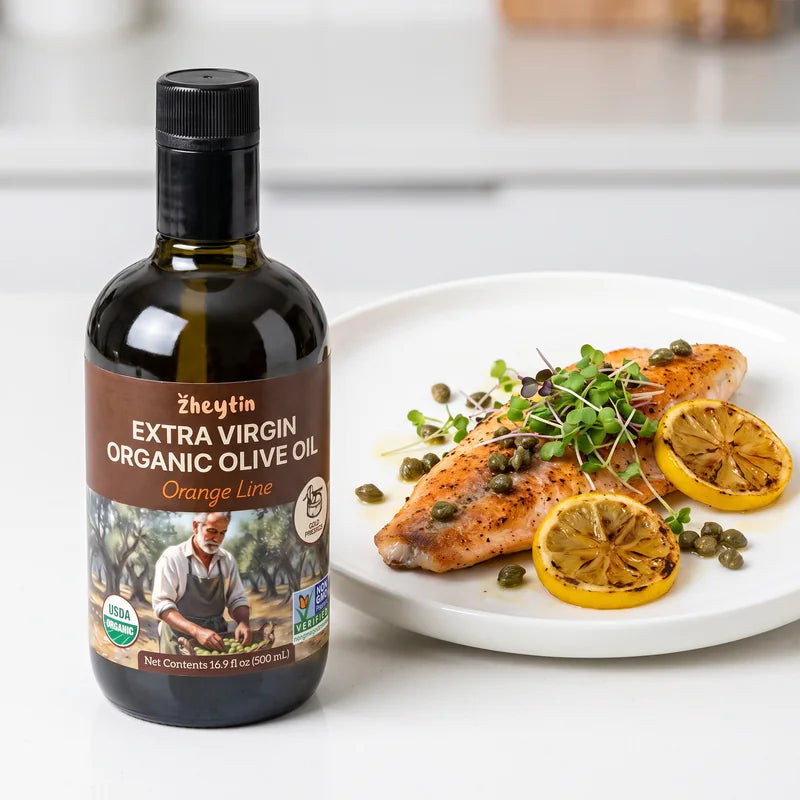
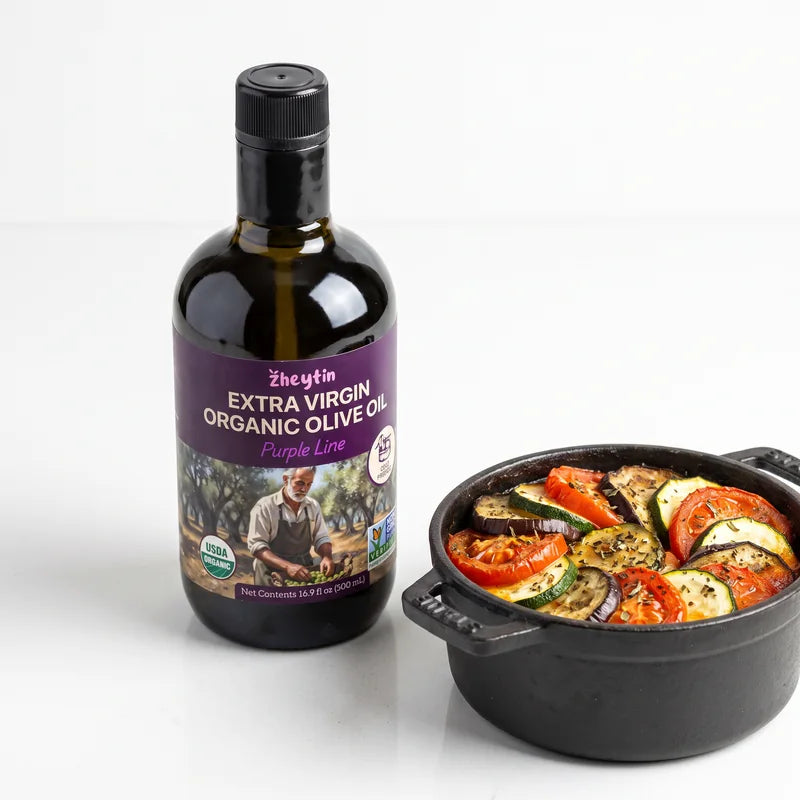
Choosing without the label words. Zheytin's three lines are chosen by how you cook: peppery Zheytin Green Line for finishing, herbaceous Zheytin Orange Line for warm dishes and Zheytin Purple Line for everyday cooking. All three are made from Memecik olives grown in Milas, Türkiye.
Ask for: the extraction system, the highest paste temperature and the step it was measured at, for the harvest in your bottle.
A cold claim describes conditions at the mill. The harvest date tells you when the olives were picked, which helps you judge the oil's age, and our guide to reading an olive oil harvest date shows where to find it and what it means.
Cold pressed olive oil FAQs
Is cold pressed olive oil better?
Not because of that word alone. "Cold pressed" says how the oil was separated, while quality shows in the grade, the harvest date and the taste. Studies don't support a simple rule that colder is better. In a 2009 industrial trial with Italian olives, oil made below 27 °C showed no higher chemical or sensory quality than oil made at 35 °C, though oil malaxed at 45 °C was rejected as "heated or burnt". Other studies found more aroma compounds with cooler processing. Choose an extra virgin olive oil with a recent harvest date, and treat a cold claim as useful when it names the system and the temperature.
How do I know if my olive oil is cold pressed?
Read the exact wording, then ask the brand. Under EU and Turkish rules, "first cold pressing" means a hydraulic press and "cold extraction" means a centrifuge or percolation, both below 27 °C. A plain "cold pressed" on a US label has no USDA definition behind it. Ask which extraction system the mill used, the highest paste temperature, the step it was measured at, and whether the mill records it for each batch. Check which harvest and batch the answer covers, and compare it with the harvest date on your bottle.
Is there a difference between first cold-pressed and cold-pressed olive oil?
Yes, in the EU and Türkiye. "First cold pressing" is reserved for oil from a first mechanical pressing on a traditional hydraulic press below 27 °C. Oil from a centrifuge below 27 °C may say "cold extraction" instead, and a plain "cold pressed" isn't one of the two EU terms. California defines both "cold pressed" and "cold extracted" without a temperature, and it counts a centrifuge as a kind of press. A University of California extension handout from around 2006 said that "almost all extraction is done with a centrifuge."
Which is better, cold-pressed or extra virgin olive oil?
They aren't alternatives. Extra virgin is the top grade of olive oil, set by lab limits such as free acidity of no more than 0.8 grams per 100 grams under the IOC and USDA standards, and by a tasting panel that finds no defects. "Cold pressed" describes how the oil was separated. In the EU, Türkiye and California, the cold terms may appear only on extra virgin or virgin olive oil, so a lawful cold term sits on top of the grade. Look for "extra virgin" first, then read any cold claim as extra detail about the mill.
What are the disadvantages of cold-pressed oil?
For a mill, the usual trade-off is yield. A 2019 Italian study opened with "Olive oil extraction conditions are usually a compromise between quality and yield", then found that raising the paste from 20 to 27 °C before centrifugation raised both yield and quality. A 2009 paper said mills often keep malaxation at 35 to 40 °C "for economic reasons". Results differ, though: in a 2021 trial, malaxing at 18 °C didn't change the yield but lowered the phenols that passed into the oil. A drawback for shoppers is that a cold claim doesn't guarantee quality.
Can I use cold-pressed olive oil for cooking?
Yes. "Cold pressed" describes how the oil was made at the mill; it isn't a cooking instruction. Choose by flavour and price: a milder oil for the pan and a more peppery one for finishing. Zheytin Purple Line, made from mature-harvest Memecik olives grown in Milas, Türkiye, is our oil for sautéing, frying and everyday cooking. Zheytin Orange Line suits warm dishes, and Zheytin Green Line is our peppery finishing oil. Control the heat, and lower it if the oil starts to smoke.
Is all extra virgin olive oil cold pressed?
Not in the legal sense. Every extra virgin olive oil must be made "solely by mechanical or other physical means under conditions, particularly thermal conditions, that do not lead to alterations in the oil", in the words of the International Olive Council's trade standard. That rules out heat that damages the oil, but it sets no temperature. The 27 °C cold terms are optional extras in the EU and Türkiye, and a 2009 study noted that the climate in many oil-producing regions makes 27 °C hard to hold during processing. An extra virgin olive oil without a cold claim can still meet the grade.
What does "cold extracted" mean on olive oil?
In the EU, "cold extraction" may appear only on extra virgin or virgin olive oil "obtained at a temperature below 27 °C by percolation or centrifugation of the olive paste", under Article 10 of Delegated Regulation (EU) 2022/2104. Türkiye's Food Codex has the same rule under the Turkish name "soğuk sıkım". It's the matching term for oil from a modern centrifuge. California defines "cold extracted" more loosely, as separation by any mechanical or physical means "at a temperature that does not lead to significant thermal alterations", with no number.
Sources & further reading
Sources checked November 14, 2026. The rule texts are quoted from the versions named in the table, with their dates. The English translations of the Turkish quotes are unofficial. Each study's findings apply to the olives and conditions it tested. The olive variety, origin and use of each Zheytin line come from Zheytin's product pages.